
Making a Pixel Art City Feel Lived In
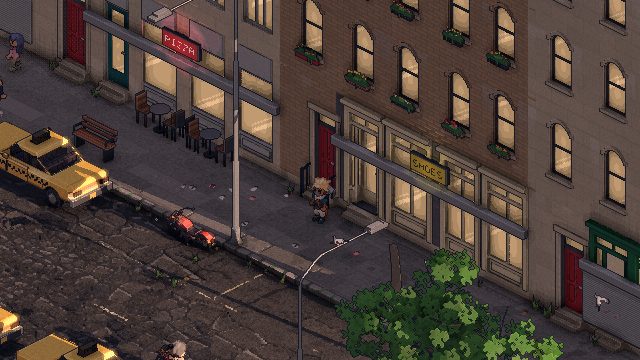
What makes a game city feel lived in isn't the number of people. It's what they do when they're not going anywhere. In Philadelphia Fiefdom people stop for a smoke or a coffee, lean in doorways, sit out on balconies on warm evenings and lean out of their windows. Shopkeepers step out onto the step when someone's passing. Cats keep their own hours, and pigeons go up the way a real flock does, one bird after another.
Last time I wrote about the street trees. This post is about everything that moves under them.
Why not just add more people?
A crowd of walkers who all have somewhere to be reads as traffic, not a neighborhood. What you notice on a real street are the people who've stopped: someone on their phone outside a shop, a couple at a café table, a neighbor watching the street from a balcony.
So the crowd is kept small and spent well. Each player has a handful of people round them, more downtown and fewer on quiet blocks, more at lunch and rush hour, fewer late at night and in bad weather. People come in out of sight and are let go once they're well behind you, so the street around you always looks lived in without the game simulating a whole city's worth of people.
Each person heads off on a trip, and what it's for depends on the hour. Between about four and half past seven, most of them are going home.
What do people do when they stop?
When someone gets where they're going, about a third of them hang around for a while before moving on. That's on purpose. If everyone lingered, the street would look staged.
- A pastime: a cigarette, a coffee, a phone, a book on a bench, or a bag of crumbs for the pigeons.
- Doorways and posts: people lean in doorways and against lamp posts and utility poles, most of them with a smoke, a coffee or a phone.
- Benches and bus shelters: sitters read, sip, smoke or feed the birds.
- Groups: friends walk together and stop to talk. Groups are most common around lunch and in the evening.
- Bad weather: once the rain gets going, nobody lingers. About 60% of people put up an umbrella. The rest hurry for shelter.
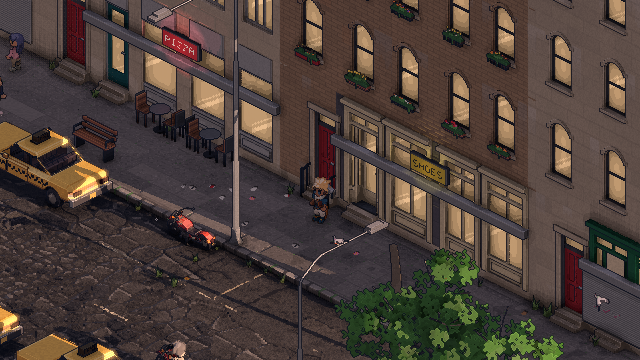 Clear
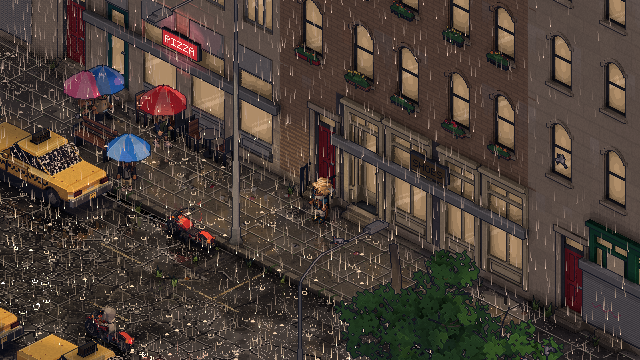 Rain
Do the shops have people in them?
Yes, and some of them come out. About 60% of shops have a keeper. When you come within a few doors of an open shop on a dry day, the keeper may step out onto the step with a smoke, a coffee or a phone, and watch the street. They go back in when you've moved on, when it starts to rain, or when you walk in to buy something.
A few named neighbors also keep daily routines: one keeps to a doorway most of the day, others make their own stops round their own corners. They only appear when you're nearby, and nothing about them runs off screen.
What about the people upstairs?
The upper floors have life too, and it follows the weather.
- Balconies, porches, fire escapes and roofs: on dry days, people sit or stand out on them. Nobody's out when it's cold. As it warms up, more of them go out, and after five in the evening twice as many. People standing out there turn to watch the traffic below.
- Open windows: windows open between seven in the morning and eleven at night, never in rain or on a wet street, and more of them the hotter it gets. At some of the open ones, somebody's leaning out.
- Sirens and crowds: people at home come to the window to see what's going on.
- Lit windows: each household gets home at its own time in the evening and goes to bed at its own time, and its lamp is on only while it's home after dark. So a block's windows light up and go out one by one.
Are there cats?
There are. Each cat has a home: a dumpster lid, a stack of boxes, a ground-floor window sill, a fire escape, a stoop. A few are out at a time near you, and each one has a temperament, from shy to bold and from friendly to aloof.
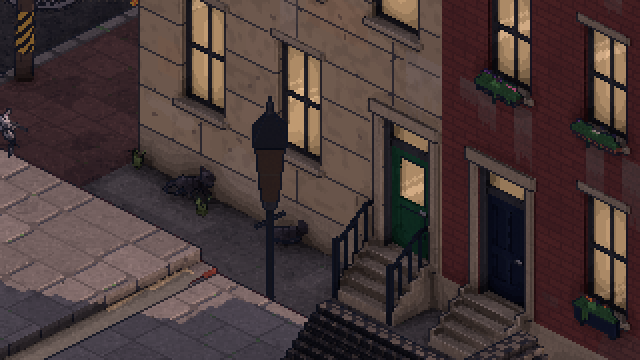
- Their day: cats are most awake around dawn and dusk, and quieter through the middle of the day.
- Weather: they shelter from rain and snow. In the cold they curl up on a steaming manhole or the warm hood of a car that's just been driven. In the heat they stretch out in the shade.
- Fear: each cat keeps its own distance from people, and that distance grows for someone running at it and grows more for a car. Crouch, and it shrinks. Loud things like horns, crashes and shots send them off too.
- Each other: cats chase each other in play.
- Feeding time: at dawn and dusk they turn up at a neighbor's door and meow to be fed.
- People: some passers-by stop and crouch to pet a friendly cat. You can too, if it trusts you or you're crouched, and it trusts you a little more each visit.
- House cats: some sit on the inside sill of a lit window, awake while their household's up and curled asleep when it isn't. On mild, dry days some go out onto the fire escape or balcony.
How do the birds work?
There are three kinds. Pigeons gather at about half the benches and bins, sparrows live in some of the street trees, and gulls pick over some of the bins. When something comes too close, a flock doesn't lift off as one. The nearest bird goes first, and the startle runs through the rest, each bird a beat later than the one before it, plus a little hesitation of its own. A runner or a car scares them from farther away than someone walking.
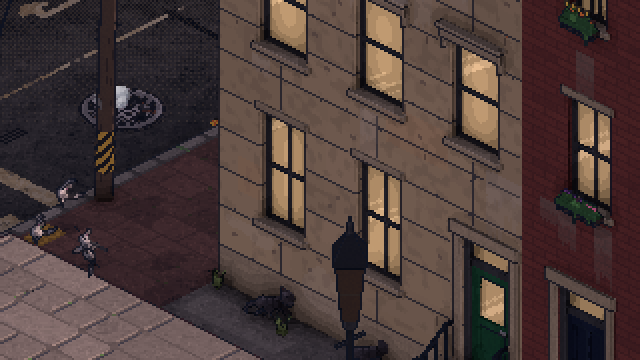
Once they're up, they fly with real momentum. A bird can't hover or turn on the spot. It banks into its turns, slows as it climbs, speeds up as it dives, and flares to land. Each species has its own style: pigeons wheel round in a loose circle that drifts, sparrows dart back into their tree, and a gull soars off on its own.
Between flights they perch on the lamp heads, signal arms, pole crossarms, hydrant caps, tree crowns and flat roofs. In bad weather most of a flock sits up high. Crouch and press Y and you'll throw them some crumbs. The flock rushes in, the gulls bully the others off, and for a while they won't be scared of you. People on benches feed them too. A cat pouncing puts them all up.
Birds are drawn by each player's own game, not sent over the network. They're the one part of the street that doesn't need to match exactly between friends, so they cost the connection nothing.
Does all this cost a lot?
Not much, because only what's near you runs in detail. People close to a player decide where to steer twelve times a second, and those farther off four times a second. Cats think five times a second. Bird flocks well away from you sleep until you come back.
Quick answers
Can you pet the cats? Yes. Crouch and press Y near a cat that trusts you. Run at it and it's gone.
Do people sit on the stoops? Not yet. People sit on benches, balconies, porches and roofs. For now, the stoops belong to the cats.
Does the weather change the street? A lot. Rain empties the street of loiterers and puts up umbrellas, cold keeps people off their balconies and shuts the windows, and warm evenings bring everyone out.
Follow along
Philadelphia Fiefdom is an online sandbox set in Philadelphia. Last time was the street trees. Next I'll get into what happens when you walk off the street and into a building. Join the playtest list to play it early, or come say hi on Discord (opens in a new tab).