
When a Car Catches Fire: Fires, Cordons and a Fire Engine Crew
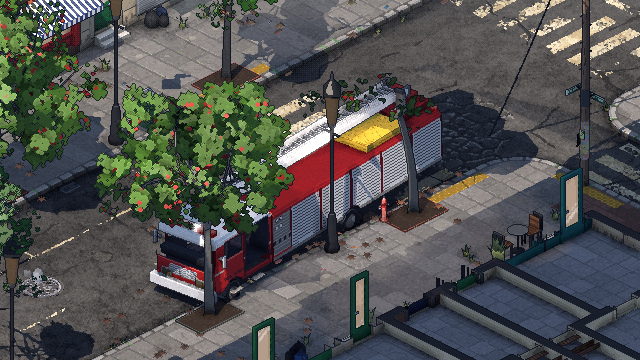
When a car catches fire in Philadelphia Fiefdom, nobody scripts what happens next. The fire grows and spreads to whatever it can reach, someone calls it in, an engine comes with its lights and siren, and a crew of four puts it out with water from their tank and then from a hydrant. Meanwhile the police close the street. Every step is the simulation working it out, so no two fires go the same way.
This post follows one car fire from start to finish, and how each part of it works.
How does a fire spread?
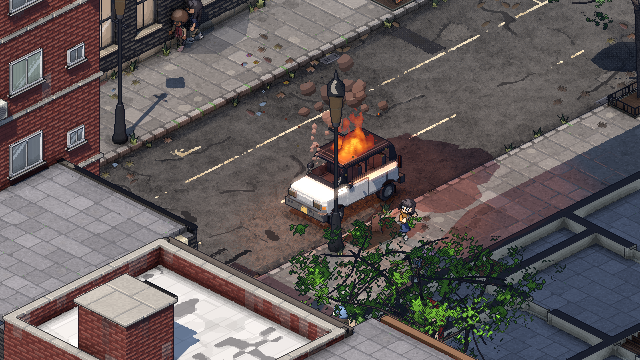
Every fire in the game is a thing in the world with a fuel, a size and a heat. A car, a person, a pile of trash, a bench, a bin, a street tree's crown, a shop's awning and the rooms of a building can all burn, each with its own fuel: how easily it catches, how fast it grows, how long it lasts.
Once a second, each fire looks at what's around it and heats it. The heat falls off with distance, goes much further downwind and more upward than down, and the wet holds it back. When something has taken in enough heat, it catches too. That's all spreading is, and it's why a car fire under a street tree can end up with the tree alight as well.
A car has one more thing going for it: its fuel tank. Some seconds after a car catches, the tank goes. The blast knocks people down, shoves the cars around it and throws burning bits across the street, which can start new fires where they land.
Rain matters too, but not equally. Falling rain holds a fire down by how much its fuel minds the wet, so a person or a pile of paper goes out, while a car keeps burning under its steel.
Who notices?
People nearby treat a fire as news. Some run, some stop and stare, and people in the buildings around it come out of their doors to look. When a fire has been burning for 20 seconds with no crew on the way, it's called in.
How does the engine get there?
The engine starts out of view on a nearby street, the one heading most directly at the fire, with its lights and siren going. From there it's part of the traffic, driving the real lanes and taking its route's turns. Cars ahead of it going the same way slow down and ease over to the curb to let it by, then pull out again. Close to the scene, it leaves the lanes and drives the last stretch however it needs to, against a one-way if that's the short way round.
What does the crew do?
An engine company is four people, and each has a job:
- The nozzle takes the nearest thing burning. He comes at it from upwind and from the engine's side, the way crews are taught, and holds back about 5 meters from a car rather than walking up to its tank. His aim swings smoothly onto the fire instead of snapping to it.
- The backup stands behind him on the line.
- The driver runs the pump panel on the side of the engine.
- The officer stands by the engine, watching the fire.
Their gear matters: in turnout coats, the crew doesn't catch fire.
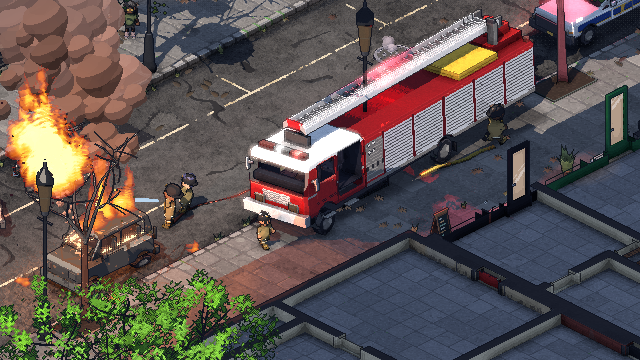 Water on
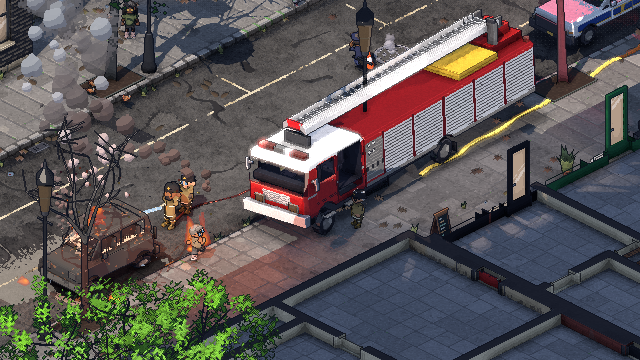 Knocked down
Where does the water come from?
At first, from the engine's own tank, which only lasts a few minutes of flow. While the nozzle works off the tank, the driver lays a supply line from the engine to the nearest hydrant, kneels there to hook it up and charges it. From then on they're on the water main and the tank isn't touched. If a car shears that hydrant off, the line goes with it and they're back on the tank.
The water goes somewhere, too. A car being hosed drips off its sills, and the street around it gets wet and dries slowly afterward.
Why is the street closed?
While the crew is there, the street around the scene is closed. Traffic stops turning into it right away, and a patrol car comes to mark it: its officer gets out and sets a taper of traffic cones across every lane coming in, then ties tape across the sidewalks at each corner. Onlookers stand at the tape to watch instead of walking into the scene. A car that drives into a cone knocks it flying, and you can pick one up and throw it.
When the fire's out and nothing has burned near them for a few seconds, the crew makes up: the supply line is taken up, they climb back in, and the engine rejoins the traffic. The officer takes the cones and the tape back in, and the street opens again. What the fire left stays: a burnt-out car shell that can't be driven, and scorch marks on what burned around it.
What about buildings?
Buildings burn room by room. Heat goes up through floors, sideways through walls and in and out through windows, and once a room is hot enough its window breaks and flames come out of it. A room burning upstairs is out of reach of a hose from the street, so the engine is parked where its aerial ladder reaches the window, the ladder is raised, and a master stream goes in at the window. Anyone cut off at their window is brought down the ladder first. Buildings are a big enough topic for a post of their own.
Quick answers
Does every fire get an engine? Every fire that burns for 20 seconds with no crew on it gets called in. Up to two engines can be out at once.
Can a fire start on its own? Now and then a room near you catches by itself, a kitchen or the wiring, about once in half an hour of play.
Does it work in co-op? Yes. The host runs the fire and the crew, and every player sees the same fire, the same hose and the same cones.
Follow along
Philadelphia Fiefdom is an online sandbox set in Philadelphia. The fire engine has to get through the traffic to reach a fire, so the next post is about the traffic: drivers with manners. Join the playtest list to play it early, or come say hi on Discord (opens in a new tab).